
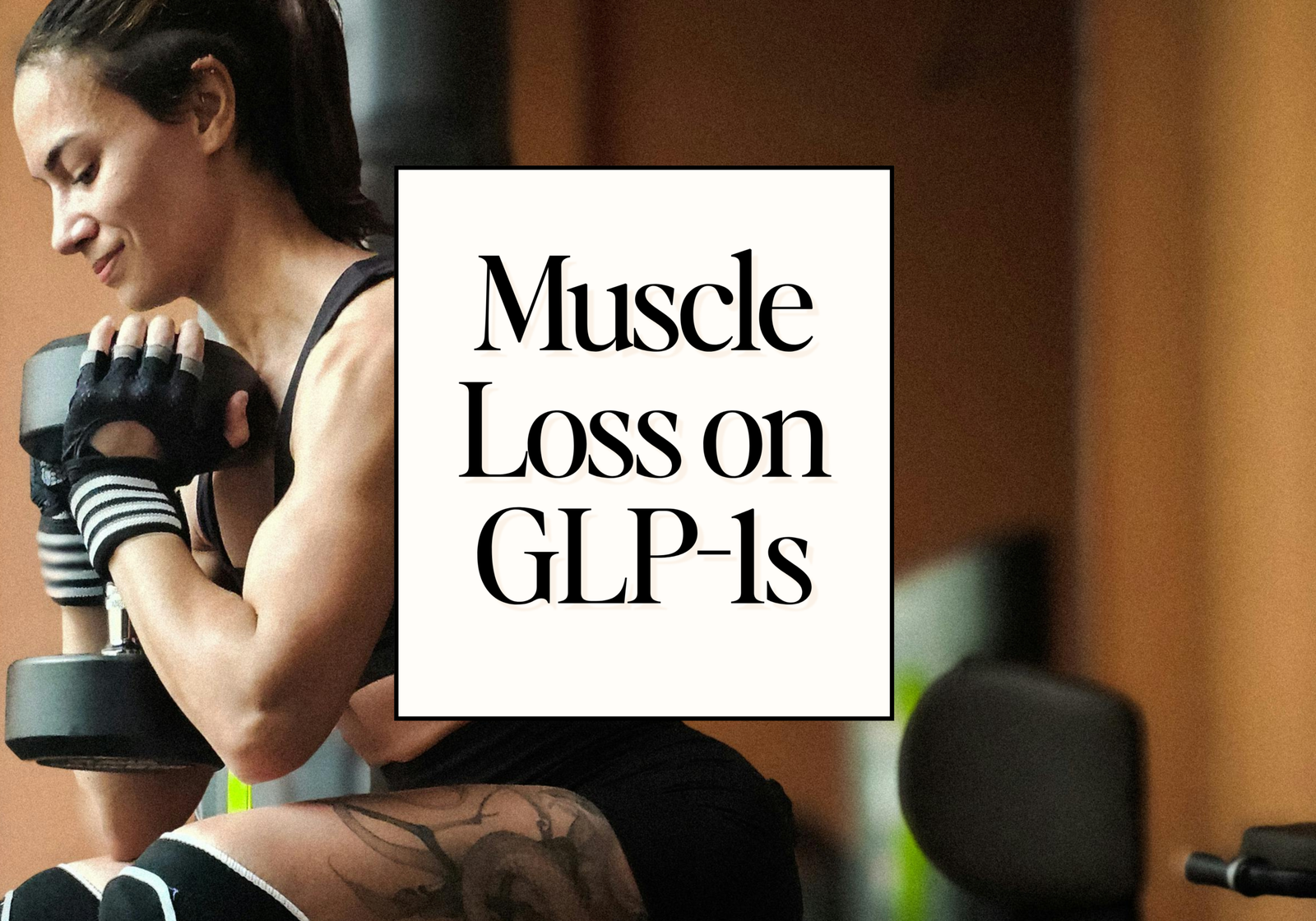
I’ll be honest, this is the post I’m most passionate about in this whole series, because protecting your muscle is the thing that turns weight loss into a body you actually feel good in, and it’s the piece almost nobody talks about until it’s a problem.
When I started, I dropped weight fast. Thirty pounds in my first three months. It felt exciting at first, but I noticed pretty quickly that I wasn’t just losing fat, I was losing muscle, and my body wasn’t looking the way I’d pictured. I’m an ISSA-certified nutritionist and personal trainer, so I knew what was happening and how to turn it around, and I did, by tracking my protein and shifting toward strength training. But I wish I’d set it up that way from day one, so let me save you the detour.
Quick disclosure: a couple of links below are affiliate links, so I may earn a small commission at no cost to you. I only recommend things I actually use.
Does semaglutide cause muscle loss?
Here’s the honest answer. When you lose weight quickly, a real share of what comes off can be lean mass, not just fat. Body-composition scans across the big trials put that share at somewhere around a quarter to 40% of the total weight lost. And here’s the part a lot of people get wrong: how much you land in that range depends more on how much weight you lose overall than on which medication you’re on. The tidy “this drug protects muscle and that one doesn’t” story floating around online doesn’t really hold up once you look at the head-to-head data, so it’s not a great reason to pick one over the other.
But here’s the context that actually matters: that’s not the drug eating your muscle. That ratio is normal for any rapid weight loss, whether it comes from a GLP-1, crash dieting, or surgery. The reason it feels bigger on these medications is simply that the total weight loss is bigger, so the absolute amount of muscle at stake is bigger too. And it’s the same root cause as the hair shedding I wrote about separately: fast loss plus thin nutrition stresses the whole body, and muscle is one of the first things it will give up. Which is exactly why the fix is in your hands.
Why muscle matters more than the number on the scale
This is the part I want every woman to hear, because so many of us start a GLP-1 thinking the whole goal is to lose weight, and then we get there and realize the scale went down but the body in the mirror isn’t what we imagined.
Muscle is what gives you shape. The curves, the tone, the strong and healthy look that reads as vibrant and younger. Lose weight without protecting muscle and you can end up smaller but softer, and honestly a little deflated, which is not what most of us were after. Muscle is also what lets you feel good and do more, carry the groceries, keep up with your kids, feel strong in your own body. And here’s a bonus that matters for the long haul: more muscle means a higher metabolism, so you can eat more without gaining. Muscle is metabolically expensive to maintain, and that works in your favor.
So the goal was never really “lose weight.” It’s “lose fat and keep muscle.” That reframe changes everything about how you do this.
Retraining your diet-culture brain
If you’ve spent years in weight-loss and diet culture, protecting muscle asks you to unlearn a few things, and the biggest one is your relationship with the scale.
When you’re building or holding muscle while losing fat, the scale might move slowly, or stall, or barely budge, even as your body composition is visibly changing and your clothes are fitting better. If the number is your only measure of success, that’s maddening. But the number isn’t telling you the whole story, and sometimes it’s actively lying to you. Take your measurements, take progress photos, notice how your clothes fit and how strong you feel. Those tell you what’s actually happening. This is the least diet-culture thing I teach, and it’s the most freeing.
The two levers that protect your muscle
Everything comes down to two things, and they work together.
The first is protein. When your appetite is suppressed, it’s genuinely hard to eat enough of it, which is exactly why muscle slips away. I had to track my protein and eat more than I felt like I wanted to, especially early on. I keep my whole low-pressure, protein-first approach and a real daily target in my protein post, so start there for the number and the reasoning.
The second is resistance training. This is the lever that actually tells your body to hold onto muscle while you lose fat. Cardio is wonderful for your heart, but it isn’t the muscle-preserving signal, so I leaned into strength work and eased back on piling on extra cardio. You don’t need a gym or anything fancy. Bodyweight moves, resistance bands, or a couple of dumbbells at home send the exact signal your muscles need.
👉 How Much Protein You Actually Need on GLP-1 (From a Nutritionist)
A simple, doable strength routine (without overdoing it)
Here’s the part where people go wrong in the other direction: they get motivated and overtrain. On a GLP-1 you’re usually eating less than you’re used to, so your body has less to recover with, and hammering yourself with daily workouts backfires.
So start gently and let your body lead. Begin with two to three days of strength training a week, and hold that steady for a few weeks. Pay attention to how you’re recovering. If you feel run down, sore for days, or wiped out, that’s usually a signal to eat more, especially more protein, not to push harder. Once the routine starts to feel easy, or your progress stalls, that’s when you add a little more, either by increasing the weight you’re lifting or by moving up to four or five days a week. Slow, steady, and sustainable beats intense and unsustainable every single time, and it’s far kinder to a body that’s already adjusting to the medication.
How I protected my muscle
For me, the turnaround came when I stopped chasing the scale and started tracking my protein and lifting consistently. The rapid loss slowed into something steadier, my body started looking the way I’d actually hoped, and I felt stronger instead of just smaller.
Muscle mattered most of all when I got to the maintenance and weaning phase, because the muscle I’d protected is a big part of why my results held. I wrote about keeping weight off after GLP-1 separately, and muscle is the throughline of that whole story.
👉 What Happens When You Stop GLP-1? What I Learned Keeping the Weight Off
What I actually use
You really don’t need much. A protein powder I trust for the days I can’t hit my target with food, a set of resistance bands, and a few small-appetite protein staples cover most of it.
I LOVE PEScience Protein Powders. They actually taste really good so I look forward to drinking them: https://amzn.to/4wSGjNa
And I’ll rotate this one in when I’m doing more heavier weight training (because of the recovery components) or if my stomach isn’t cooperating with dairy/whey products: https://amzn.to/4qGj7QJ
When to check in with your provider
Most muscle change on a GLP-1 is manageable with protein and training, but a few things are worth a conversation: weight dropping very fast, noticeable weakness, or feeling frail rather than just lighter. Those are worth raising with your provider, who may look at your rate of loss or your dose. And as always, don’t stop or change your dose on your own. The fix for losing muscle is almost never quitting the medication, it’s protein, lifting, and sometimes easing the pace.
The bottom line
Muscle is what makes GLP-1 results worth having: the shape, the strength, the metabolism, and the staying power. You protect it with two simple things done consistently, enough protein and regular strength training, plus the willingness to trust your measurements over the scale. Start gentle, fuel your body, lift a couple of times a week, and let your results be the kind you can actually keep. This is the part I wish someone had told me on day one, so now you know.
This article is for education and is not medical or fitness-prescription advice. Individual experiences vary. Talk with a licensed provider before starting a new exercise or supplement routine, and do not stop or change your medication on your own. Last reviewed: August 2026.

6 Comments